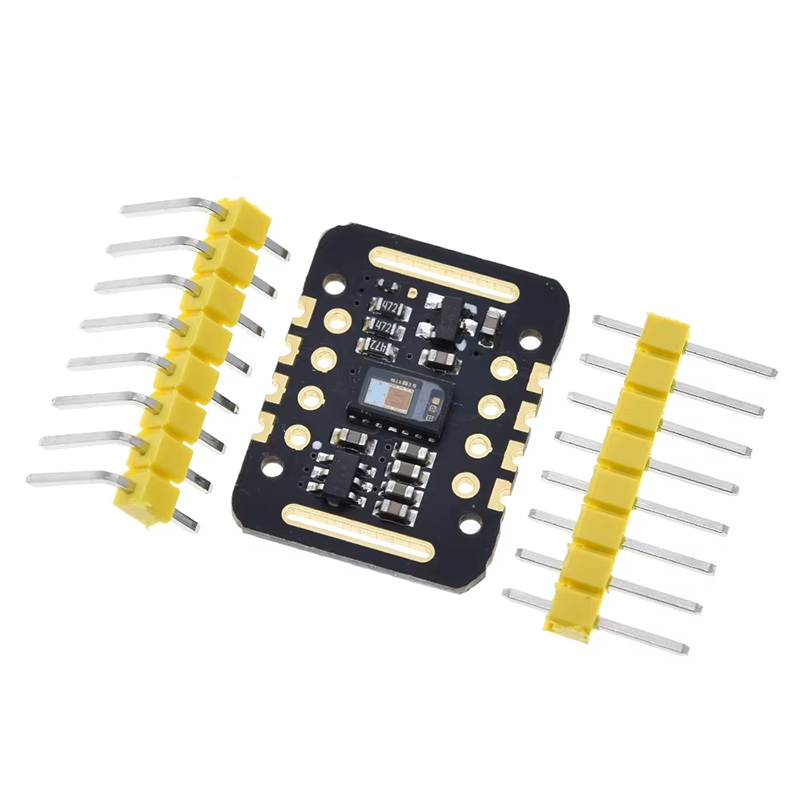
The MAX30102 Heart Rate and Pulse Oximeter Sensor Module is an optical sensing board for collecting photoplethysmography (PPG) data in embedded and wearable electronics projects. It uses integrated red and infrared LEDs with a photodetector to capture pulse-related signals, which software can process to estimate heart rate and blood oxygen saturation (SpO2). Communication with a microcontroller is through I2C.
Key Features
Heart-Rate Signal Sensing
Captures optical pulse signals that can be processed by a suitable algorithm to estimate heart rate.
SpO2 Data Capture
Red and infrared measurements provide input for software-based blood oxygen saturation estimation.
Integrated Red and IR LEDs
Built-in 660nm red and 880nm infrared light sources support reflective optical sensing.
Photoplethysmography
Uses changes in reflected light to capture pulse-related variations in blood volume.
I2C Interface
Connects to compatible microcontrollers through the serial clock and serial data lines.
Compact Sensor Design
Suitable for prototyping wearable concepts, biometric demonstrations and electronics experiments.
Technical Specifications
| Sensor IC |
MAX30102 |
| Sensor Type |
Optical heart-rate and pulse-oximetry biosensor |
| Measurement Method |
Photoplethysmography (PPG) |
| Optical Sources |
Red LED: 660nm; Infrared LED: 880nm |
| Communication |
I2C-compatible interface |
| Sensor ADC |
18-bit |
| Core Supply (IC) |
1.8V typical |
| LED Supply (IC) |
3.3V typical (device specification allows 3.1V–5.0V) |
| Operating Temperature (IC) |
-40°C to +85°C |
| Functions |
PPG data capture for heart-rate and SpO2 estimation |
Module voltage note: The MAX30102 chip itself requires separate core and LED supply rails. Breakout boards may add voltage regulation and level shifting, but board designs vary. Confirm the exact module’s input-voltage and I2C logic-level requirements before connecting it to a 3.3V or 5V controller.
Compatible Devices and Controllers
- Arduino boards with a compatible I2C interface and suitable voltage-level handling
- ESP32 and ESP8266 development boards using 3.3V I2C logic
- Raspberry Pi boards using I2C, with the correct breakout-board power and logic requirements
- Other microcontrollers that support I2C communication
Controller compatibility depends on the breakout board’s regulator, pull-up resistors, logic voltage and software library. Check these before wiring.
Applications
- Wearable electronics and fitness-device prototypes
- Heart-rate sensing demonstrations and educational projects
- Optical PPG data collection and signal-processing experiments
- IoT biometric-data prototypes and microcontroller projects
- Learning I2C communication and optical sensor integration
Connection and Setup Guide
- Identify the breakout board’s printed pin labels, supply input range and logic-level requirements before powering it.
- Connect the module’s SDA and SCL pins to the controller’s I2C data and clock pins.
- Connect GND between the module and controller. Connect the supply pin only to a voltage supported by the specific breakout board.
- Install a MAX30102-compatible software library for your development environment.
- Run an I2C scanner or the library’s example to confirm that the sensor responds on the bus.
- Keep the sensor stable against a fingertip, minimise ambient light leakage and movement, then collect red and infrared samples.
- Use an appropriate signal-processing algorithm to estimate pulse rate and SpO2 from the collected PPG data.
Important Before Buying
- This is a development sensor module, not a certified medical pulse oximeter or diagnostic device. Do not use its readings for medical decisions.
- The sensor provides optical data; heart-rate and SpO2 values require suitable software algorithms and careful signal processing.
- Do not assume every MAX30102 breakout accepts 5V. The IC has a 1.8V core supply and a separate LED supply; verify the breakout’s onboard circuitry.
- Check I2C pull-up voltage and controller logic compatibility to avoid damaging 3.3V-only GPIO pins.
- Movement, poor finger contact, ambient light, skin perfusion and software configuration can affect measurement quality.
- Additional controller boards, connecting wires and accessories are not confirmed as included.
Frequently Asked Questions
What does the MAX30102 sensor module do?
It captures red and infrared optical signals that can be processed to estimate heart rate and blood oxygen saturation in suitable electronic projects.
Does MAX30102 measure heart rate and SpO2?
It captures the optical PPG data used by software algorithms to estimate these values. The sensor does not provide medically validated readings by itself.
Which communication interface does it use?
The MAX30102 uses an I2C-compatible interface, typically connected through SDA and SCL.
Can I use it with Arduino?
Yes, it can be used with compatible Arduino boards through I2C when the breakout-board supply and logic levels are suitable for the controller.
Can I connect it to ESP32 or ESP8266?
Yes. These controllers provide I2C and 3.3V logic. Confirm the breakout board’s power input and I2C pull-up voltage before connecting.
Can I power every MAX30102 module with 5V?
No. The bare IC requires a 1.8V core rail and a separate LED supply. Some breakout boards include regulators for easier input, but you must verify the specifications of the exact board you receive.
Why do readings change when my finger moves?
Movement can disturb the optical signal and introduce noise into PPG measurements. Keep the sensor and finger steady, maintain consistent contact and use suitable filtering and processing.
Is this suitable for medical or clinical monitoring?
No. This development module is intended for prototyping and education, not diagnosis, treatment or clinical monitoring. Use an appropriately certified medical device for health decisions.
Why Buy from PcGuy Computers?
- Electronics and sensor modules for development and STEM projects
- Product information focused on technical compatibility and safe setup
- Online ordering for customers across Pakistan
- Assistance with selecting components for your project requirements
Buy MAX30102 Heart Rate and Pulse Oximeter Sensor Module in Pakistan
Looking to buy a MAX30102 Heart Rate and Pulse Oximeter Sensor Module in Pakistan? Order online from PcGuy Computers for Arduino, ESP32, wearable-electronics and optical PPG development projects. Check the breakout board’s power and logic-level requirements before connecting.
 Pick up from PcGuy Computers Store
 AusPost Standard
 AusPost Express


 Arduino Modules & Sensors
 Battery Compartments
 Component Cases
 Electronics Kits
 Microcontroller Boards
 Project Enclosures
 Shields & Hats
 Tablets
 Laptops
 Laptop Accessories
 CPU (Processor)
 CPU Coolers
 GPU (Graphics)
 HDD/ SSD (Storage)
 MOBO (Motherboard)
 PSU (Power Supply)
 RAM (Memory)
 Keyboard & Mouse Combo
 Keyboards
 Printers
 USB
Reviews
There are no reviews yet.