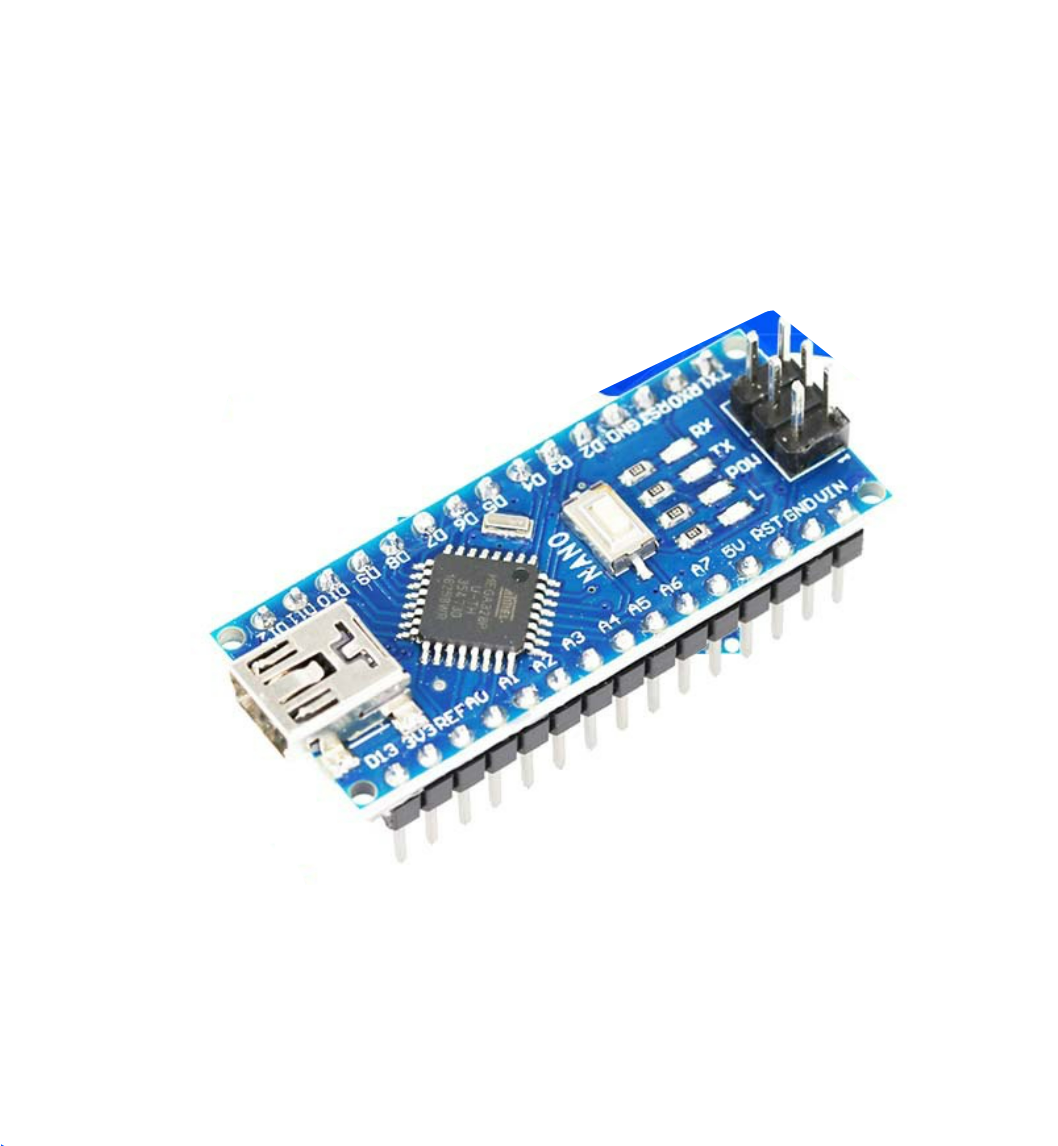
The ATmega328P Nano V3.0 CH340 Development Board is a compact, breadboard-friendly microcontroller board for Arduino-compatible electronics projects. It combines an ATmega328P running at 16MHz with a CH340 USB-to-serial interface, making it suitable for programming and controlling sensors, displays, motors and other low-voltage modules.
Key Features
ATmega328P MCU
Runs Arduino-compatible sketches for embedded control, automation and prototyping.
CH340 USB Interface
Provides USB-to-serial communication for uploading sketches and serial monitoring.
16MHz Clock
Operates at the standard 16MHz clock frequency used by classic Nano V3 boards.
14 Digital I/O
Connect digital inputs and outputs, with six pins supporting PWM output.
8 Analogue Inputs
Read analogue sensor signals through A0–A7; A6 and A7 are analogue-input only.
Compact Nano Format
Breadboard-friendly layout for compact prototypes, robotics and embedded builds.
Technical Specifications
| Board Type |
Nano V3.0 compatible development board |
| Microcontroller |
ATmega328P |
| USB-to-Serial Chip |
CH340 |
| Operating Logic Voltage |
5V DC |
| Recommended VIN |
7V–12V DC |
| Clock Speed |
16MHz |
| Digital I/O Pins |
14 (D0–D13) |
| PWM Outputs |
6 (D3, D5, D6, D9, D10, D11) |
| Analogue Inputs |
8 (A0–A7; A6 and A7 analogue-only) |
| Flash Memory |
32KB (approximately 2KB used by bootloader) |
| SRAM |
2KB |
| EEPROM |
1KB |
| USB Connector |
Mini USB (as listed; confirm physical connector on supplied board) |
| Programming |
Arduino IDE / compatible AVR development tools |
Compatible Devices and Development Tools
- Arduino IDE on Windows, macOS and Linux
- Arduino-compatible libraries and Nano V3 sketches
- Digital sensors, analogue sensors, LEDs, displays and suitable driver modules
- UART, I²C and SPI peripherals supported by the ATmega328P
- CH340 USB serial driver on computers where the operating system does not install it automatically
Applications
- Arduino learning, coding and electronics prototyping
- Robotics and small robot control systems
- Sensor monitoring and data collection
- LED, LCD and OLED display projects
- Home automation and simple control systems
- Embedded projects where a compact 5V microcontroller is suitable
Connection and Setup Guide
- Connect the board to your computer using a data-capable Mini USB cable.
- Install the CH340 USB serial driver if your computer does not recognise the board or create a serial port automatically.
- Open Arduino IDE and select Arduino Nano under Tools > Board.
- Select the detected serial port under Tools > Port.
- For a compatible ATmega328P clone, try the processor setting that matches its bootloader. Some older Nano-compatible boards require ATmega328P (Old Bootloader).
- Upload a simple test sketch, such as Blink, before connecting additional modules.
- For external power, use the VIN input within the board’s supported range. Use a regulated 5V supply on the 5V pin only when you understand the board’s power path.
Important Before Buying
- This is an Arduino-compatible CH340-based board, not an original branded Arduino board.
- The board’s logic operates at 5V. It is not a 3.3V-native development board; protect 3.3V-only modules and inputs from 5V signals.
- Do not apply 7V–12V to the 5V pin. The recommended external input range applies to VIN, not the regulated 5V rail.
- Do not power motors, servos or other high-current loads directly from GPIO pins. Use suitable driver circuits and a correctly rated external supply.
- CH340 driver installation or selecting the correct Nano bootloader option may be necessary if uploading fails.
- Exact board dimensions, header-pin inclusion and cable inclusion are not confirmed for this listing. Check the supplied product photos and package details.
Frequently Asked Questions
What is the ATmega328P Nano V3.0 CH340 board?
It is a compact Arduino Nano-compatible development board built around the ATmega328P microcontroller and CH340 USB-to-serial interface.
Can I program it using Arduino IDE?
Yes. Select Arduino Nano as the board, choose the correct serial port and select the matching ATmega328P bootloader option if required.
Why does my computer not detect the board?
Check the USB cable supports data, try another USB port and install the CH340 driver if needed. Also check whether the board’s power LED turns on.
How many digital and analogue pins are available?
The Nano layout provides 14 digital I/O pins and 8 analogue inputs. A6 and A7 are analogue-input only.
Which pins support PWM?
The six PWM-capable pins are D3, D5, D6, D9, D10 and D11.
What voltage should I use to power the board?
The board operates at 5V logic. A typical recommended external input through VIN is 7V–12V DC. Do not apply that voltage to the 5V pin.
Why do I get an upload error with the old bootloader?
Nano-compatible boards can ship with different bootloader versions. In Arduino IDE, try Tools > Processor > ATmega328P (Old Bootloader) if the standard setting does not upload successfully.
Can I connect 3.3V sensors directly?
Some 3.3V sensors can accept 5V power but still require 3.3V logic. Check the sensor specifications and use suitable level shifting where needed. Never assume every module is 5V tolerant.
Why Buy from PcGuy Computers?
- Pakistan-based ordering and customer support
- Product information to help choose compatible electronics components
- Assistance with basic product and project queries
- Convenient online ordering through PcGuy Computers
Buy ATmega328P Nano V3.0 CH340 Development Board in Pakistan
Order the ATmega328P Nano V3.0 CH340 Development Board from PcGuy Computers for Arduino-compatible coding, robotics, sensor interfacing and compact embedded electronics projects. Check your power requirements and peripheral logic levels before connecting external hardware.
 Pick up from PcGuy Computers Store


 Pick up from PcGuy Computers Store
 AusPost Standard
 AusPost Express
 Arduino Modules & Sensors
 Battery Compartments
 Component Cases
 Electronics Kits
 Microcontroller Boards
 Project Enclosures
 Shields & Hats
 Tablets
 Laptops
 Laptop Accessories
 CPU (Processor)
 CPU Coolers
 GPU (Graphics)
 HDD/ SSD (Storage)
 MOBO (Motherboard)
 PSU (Power Supply)
 RAM (Memory)
 Keyboard & Mouse Combo
 Keyboards
 Printers
 USB
Reviews
There are no reviews yet.