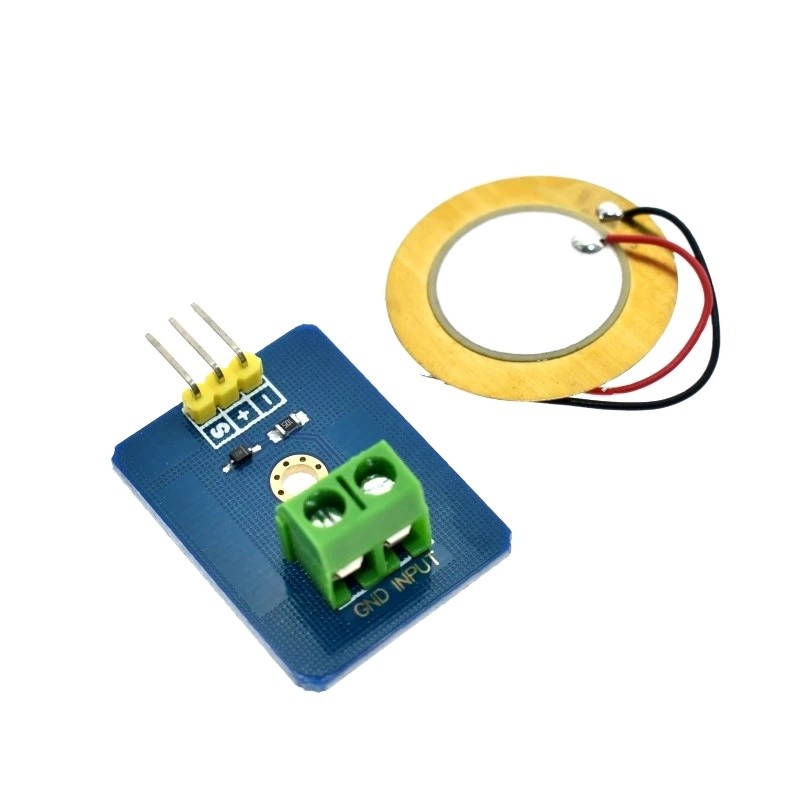
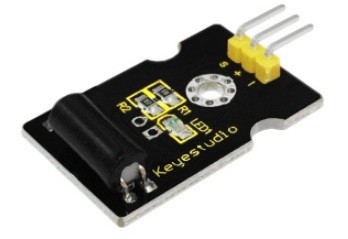
The Analog Piezoelectric Ceramic Vibration Sensor Module detects knocks, taps, impacts and mechanical vibrations, converting them into an analogue electrical signal. It is designed for Arduino and compatible electronics projects where a controller needs to sense changes in vibration strength rather than simply receive a basic on/off trigger.
Key Features
Piezoelectric Detection
Uses a ceramic piezoelectric element that generates an electrical response when it is flexed or vibrated.
Analogue Signal Output
Provides changing analogue readings that can be sampled to compare relative vibration or impact intensity.
Low Power Operation
Typical module specifications list a working current below 1mA.
3.3V–5V Supply
Designed for common low-voltage microcontroller projects using a compatible 3.3V or 5V supply.
Simple Controller Interface
Connects to an analogue input on boards that include an ADC, such as Arduino Uno.
Flexible DIY Uses
Useful for knock detection, electronic drum experiments, vibration alerts and interactive prototypes.
Technical Specifications
| Product Type |
Analogue piezoelectric ceramic vibration sensor module |
| Sensing Principle |
Piezoelectric effect |
| Operating Voltage |
3.3V–5V DC |
| Working Current |
Less than 1mA (typical published specification) |
| Output |
Analogue signal |
| Operating Temperature |
-10°C to +70°C (published module specification) |
| Detection |
Mechanical vibration, taps, knocks and impacts |
| Module Dimensions |
Not confirmed for this exact stock variant |
| Brand / Exact Model |
Not confirmed for this listing |
Compatible Devices and Controllers
- Arduino Uno, Nano and other boards with a suitable analogue input
- ESP32 and ESP8266 development boards, subject to their ADC input voltage limits
- STM32 and other microcontrollers with analogue-to-digital conversion
- Raspberry Pi when used with a separate compatible analogue-to-digital converter (ADC)
Applications
- Knock and tap detection for interactive projects
- DIY vibration monitoring and event logging
- Electronic drum and percussion experiments
- Robotics and impact-response prototypes
- Vibration-triggered alerts and educational demonstrations
- STEM and piezoelectric-effect experiments
Connection and Setup Guide
- Check the labels on your module before wiring. Common three-pin labels are S (signal), + (VCC) and – (GND).
- Connect VCC to a suitable 3.3V or 5V supply and GND to the controller ground.
- Connect S to an analogue input, such as A0 on an Arduino Uno.
- Upload a sketch that reads the analogue input and prints the values to the Serial Monitor.
- Gently tap or vibrate the ceramic sensing element and observe how the readings change.
- Adjust your software threshold and sampling method for the intended project. Use suitable signal conditioning if required.
Important Before Buying
- This is an analogue sensor, not a calibrated vibration meter. Readings depend on mounting, sensor placement, mechanical coupling and the test setup.
- Piezo elements can produce brief voltage spikes. Protect the controller input from signals outside its permitted voltage range; add suitable clamping or conditioning where necessary.
- ESP32, ESP8266 and other 3.3V ADC inputs must not be exposed to an out-of-range signal. Check the exact board’s ADC limits.
- A standard Raspberry Pi does not have a built-in analogue input; use an external ADC.
- A pin labelled NC on some board variants may be unused or assigned differently. Follow the actual PCB labels and documentation for your supplied version.
- Exact dimensions, brand, model number and included accessories have not been independently confirmed for this stock listing.
Frequently Asked Questions
What does an analogue piezoelectric vibration sensor do?
It converts mechanical stress, knocks or vibration into an electrical signal. A microcontroller can read the analogue output and compare changes in signal level.
Does this module detect vibration intensity?
It provides analogue readings that can indicate relative changes in vibration or impact. It is not a calibrated instrument for measuring vibration amplitude or acceleration.
What is its operating voltage?
Published specifications for this module type state a 3.3V to 5V DC supply. Confirm the board markings before connecting power.
Can I use it with Arduino Uno?
Yes. Connect the analogue signal pin to an Arduino Uno analogue input such as A0, connect power and ground, then read the input using analogRead().
Can I connect it directly to a Raspberry Pi?
No analogue input is built into a standard Raspberry Pi. Use a compatible external ADC and ensure the signal is within the ADC’s permitted input range.
Can it be used with ESP32 or ESP8266?
It can be used with a suitable analogue input, but check the controller’s ADC voltage limits and protect the input from piezoelectric voltage spikes.
Is this a digital vibration switch?
No. This listing is for an analogue-output module. Your code can apply a threshold to the readings if you want to trigger a digital-style event.
Is it suitable for accurate industrial vibration measurement?
It is intended for DIY and educational projects. Accurate measurement requires appropriate mechanical mounting, signal conditioning, calibration and a sensor designed for the measurement standard.
Why Buy from PcGuy Computers?
- Pakistan-based ordering and customer support
- Product information to help you choose compatible electronics components
- Assistance with basic product and project queries
- Convenient online ordering through PcGuy Computers
Buy Analog Piezoelectric Ceramic Vibration Sensor Module in Pakistan
Order the Analog Piezoelectric Ceramic Vibration Sensor Module from PcGuy Computers for Arduino experiments, knock detection, vibration-responsive robotics and DIY electronics projects. Check your controller’s analogue input limits and required signal protection before installation.
 Pick up from PcGuy Computers Store


 Pick up from PcGuy Computers Store
 AusPost Standard
 AusPost Express
 Arduino Modules & Sensors
 Battery Compartments
 Component Cases
 Electronics Kits
 Microcontroller Boards
 Project Enclosures
 Shields & Hats
 Tablets
 Laptops
 Laptop Accessories
 CPU (Processor)
 CPU Coolers
 GPU (Graphics)
 HDD/ SSD (Storage)
 MOBO (Motherboard)
 PSU (Power Supply)
 RAM (Memory)
 Keyboard & Mouse Combo
 Keyboards
 Printers
 USB
Reviews
There are no reviews yet.