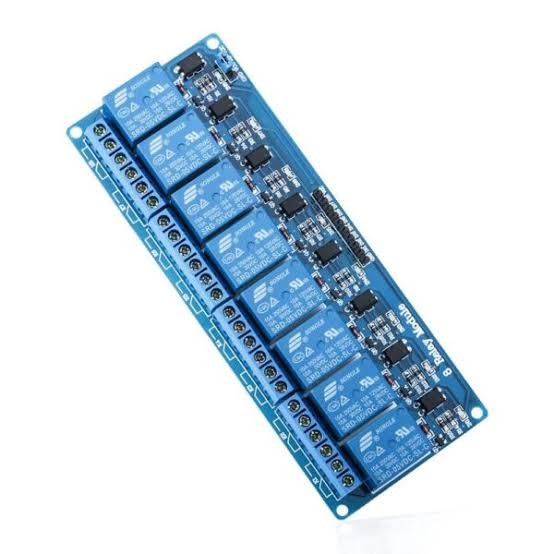
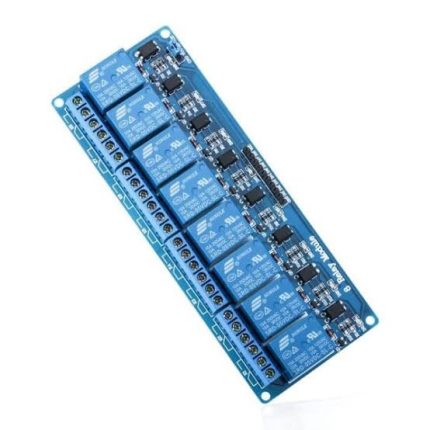
The 12V 8 Channel LT Relay Module is an eight-channel switching board for controlling separate electrical circuits from a compatible controller or automation system. Each channel uses a changeover relay with COM, NO and NC contacts, allowing suitable external loads to be switched independently. The relay circuitry is designed for a 12V DC supply.
Key Features
Eight Relay Channels
Provides eight relay outputs for controlling multiple external circuits from one board.
Independent Control
Individual channel inputs allow compatible control systems to operate relays separately.
12V DC Relay Supply
Designed for a suitable 12V DC supply for the relay circuitry.
COM / NO / NC Contacts
Changeover contacts support normally open or normally closed circuit arrangements.
Screw-Terminal Connections
Terminal connections provide a practical way to wire external circuits to the relay contacts.
Automation Applications
Useful for compatible lighting, pump, fan, solenoid and multi-channel control projects.
Product Specifications
| Product Type |
LT Multi-Channel Relay Module |
| Relay Channels |
8 |
| Relay Supply |
12V DC |
| Channel Control |
Individual trigger inputs |
| Relay Contact Type |
Changeover / SPDT |
| Contact Terminals |
COM / NO / NC |
| Load Connections |
Screw terminals |
| Switching Mechanism |
Electromechanical relays |
| Trigger Polarity / Logic |
Not confirmed; check the supplied board |
| Contact Voltage / Current Rating |
Check the markings on the relays and PCB before connecting a load |
How the Relay Contacts Work
- COM (Common): The shared contact for each relay’s switched circuit.
- NO (Normally Open): Normally disconnected from COM; connects to COM when the relay is activated.
- NC (Normally Closed): Normally connected to COM; disconnects from COM when the relay is activated.
Choose NO or NC according to the required default state of the external circuit. The relay contacts switch the external load; the load’s power does not pass through a controller GPIO pin.
Power and Controller Compatibility
Use a suitable 12V DC supply for the relay board. Select a supply with enough current for the number of relays that may be energised at the same time. The 12V relay supply specification is separate from the voltage and current switched through the COM, NO and NC contacts.
- Confirm the input trigger voltage and active-high or active-low behaviour from the actual board markings or documentation.
- Do not assume a 3.3V ESP32, ESP8266 or Raspberry Pi GPIO signal will trigger this module directly.
- Use suitable interface circuitry when the controller’s output does not meet the module’s input requirements.
- Check whether the particular board requires a shared controller ground; do not assume its control circuitry is isolated.
- Arduino, ESP, Raspberry Pi and PLC integration depends on compatible input signalling and wiring.
Load Ratings and Electrical Safety
The exact contact rating, PCB current capacity and trigger logic are not established by the product name alone. Check the printed ratings on the supplied relays and board before connecting equipment. AC and DC contact ratings can differ, and motor or solenoid startup current may be higher than normal running current.
- Do not exceed the relay, PCB trace, terminal or wire ratings.
- Consider suitable flyback suppression for DC coils and appropriate snubbers or transient protection for other inductive loads.
- Use suitable fusing and wiring for the connected circuit.
- For mains-voltage switching, use an appropriate enclosure, insulation, clearances, earthing and over-current protection. Mains wiring should be handled by a qualified person.
- Do not assume the board is optically isolated unless the supplied board’s isolation components and layout confirm it.
Typical Applications
- Multi-zone lighting control
- Arduino and microcontroller automation
- Suitable water pump and solenoid switching
- Fan and ventilation control
- Alarm and access-control projects
- Robotics, test equipment and DIY electronics
Frequently Asked Questions
How many channels does this relay module have?
It has eight relay channels for switching up to eight separate circuits, subject to the electrical ratings of the relays, PCB and connections.
What supply voltage does this module require?
This version is designed for a 12V DC relay supply. Confirm the board’s printed voltage markings before powering it.
Can each relay be controlled separately?
Yes. The board provides individual trigger inputs for its eight relay channels.
What are COM, NO and NC?
COM is the common contact, NO is normally open, and NC is normally closed. Their connection changes when the relay is energised.
Can I use this module with Arduino?
It can be integrated with a compatible Arduino control output. Check the module’s trigger voltage and input logic before wiring it directly to the board.
Will it work directly with an ESP32 or Raspberry Pi?
That is not guaranteed. These controllers commonly use 3.3V GPIO, so confirm the relay board’s trigger requirements and use suitable interface circuitry if needed.
Does the 12V supply mean it can only switch 12V loads?
No. The 12V figure refers to the relay module supply. The switched circuit is separate, but its voltage and current must remain within the actual relay and board ratings.
Can it switch a water pump or solenoid valve?
Potentially, if the load’s operating and startup current are within the confirmed contact and board ratings. Inductive loads may also need suitable transient suppression.
Can all eight relays operate at the same time?
The module has eight channels, but simultaneous operation requires a 12V supply with sufficient current for the combined coil load. Confirm the supply requirements for the exact board.
Is the board active-high or active-low?
The trigger polarity is not confirmed here. Check the input labels or documentation supplied with the specific board before programming your controller.
Is this relay module optically isolated?
Optical isolation is not confirmed. Do not assume the control side is galvanically isolated unless the components and circuit layout on the supplied board verify it.
Can I use it to switch mains electricity?
Only if the actual relay and board ratings support the intended load and the installation has suitable enclosure, insulation, clearances and protection. Mains wiring should be performed by a qualified person.
Why Buy from PcGuy Computers?
| Electronics Components |
Explore components for electronics, robotics and DIY projects. |
| Relay & Switching Range |
Browse relay modules and related switching accessories. |
| Development Hardware |
Find compatible project components, controllers and modules. |
| Pakistan-Focused Store |
Shop electronics and computer accessories through PcGuy Computers in Pakistan. |
The 12V 8 Channel LT Relay Module is a practical option for compatible multi-output switching projects. Confirm trigger logic, contact ratings and supply requirements on the actual board before installation.
 Pick up from PcGuy Computers Store


 Pick up from PcGuy Computers Store
 AusPost Standard
 AusPost Express
 Arduino Modules & Sensors
 Battery Compartments
 Component Cases
 Electronics Kits
 Microcontroller Boards
 Project Enclosures
 Shields & Hats
 Tablets
 Laptops
 Laptop Accessories
 CPU (Processor)
 CPU Coolers
 GPU (Graphics)
 HDD/ SSD (Storage)
 MOBO (Motherboard)
 PSU (Power Supply)
 RAM (Memory)
 Keyboard & Mouse Combo
 Keyboards
 Printers
 USB
Reviews
There are no reviews yet.