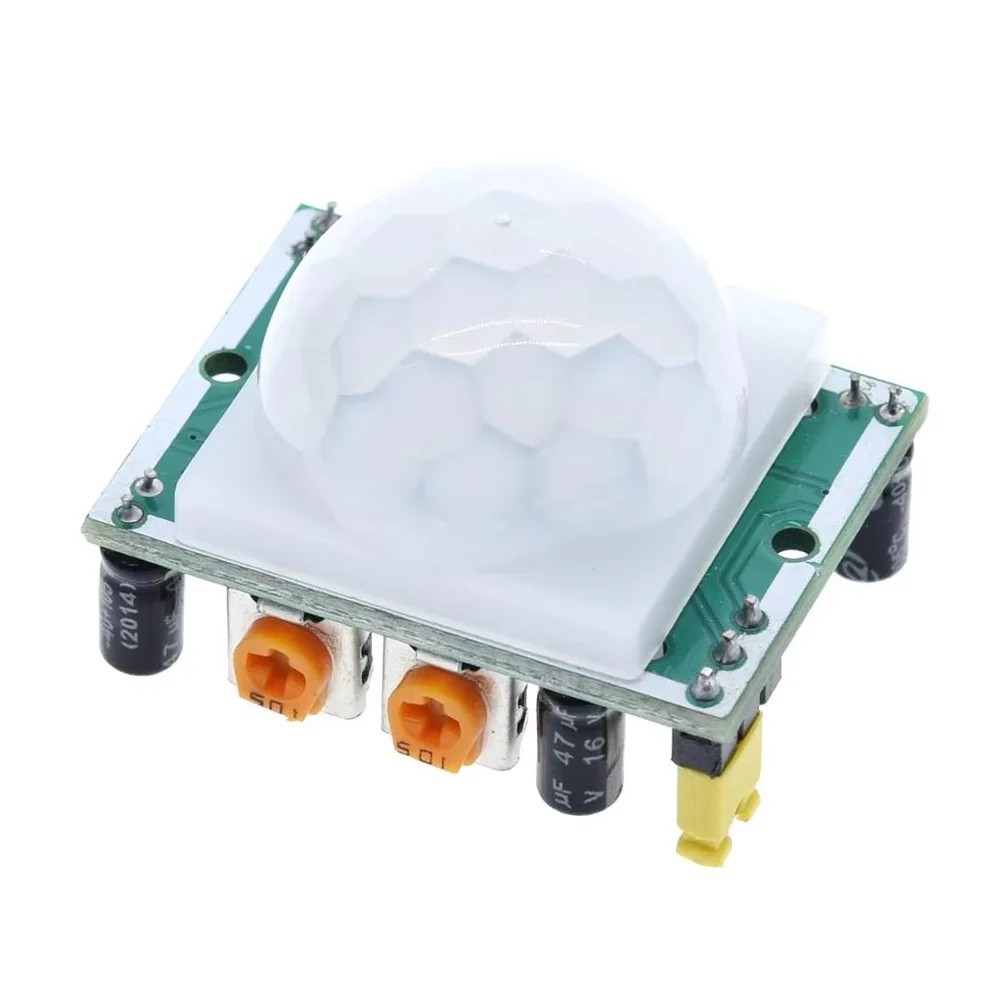
The HC-SR501 Infrared PIR Motion Sensor Module detects movement by sensing changes in infrared radiation from people and other warm objects. It provides a digital HIGH signal when motion is detected and returns LOW when the trigger period ends. With adjustable sensitivity, adjustable output delay and selectable repeat-trigger mode, it is useful for Arduino motion alarms, automatic lighting and home-automation prototypes.
Key Features
Passive Infrared Detection
Detects changes in infrared energy across its field of view without emitting an infrared beam.
Adjustable Sensitivity
Use the onboard sensitivity potentiometer to tune the detection distance for your environment.
Adjustable Time Delay
Set how long the digital output stays HIGH after motion is detected.
Two Trigger Modes
Select repeatable (H) or non-repeatable (L) triggering using the jumper.
3.3V Digital Output
Provides a 3.3V HIGH / 0V LOW signal for compatible controller inputs.
Wide Area Coverage
Common versions offer a detection angle of up to approximately 120° and adjustable range.
Technical Specifications
| Model |
HC-SR501 |
| Sensor Type |
Passive Infrared (PIR) |
| Controller IC |
BISS0001 (common module configuration) |
| Supply Voltage |
5–20V DC (check your board revision; 5V is commonly used) |
| Output Type |
Digital TTL signal |
| Output Logic |
LOW when idle; HIGH (approximately 3.3V) when motion is detected |
| Detection Range |
Approximately 3–7m, adjustable and environment-dependent |
| Detection Angle |
Up to approximately 120° (variant and installation dependent) |
| Delay Time |
Adjustable; commonly around 0.3 seconds to 5 minutes |
| Trigger Modes |
H: repeatable; L: non-repeatable |
| Initialization |
Allow approximately 30–60 seconds after power-up for stabilisation |
| PCB Dimensions |
Approximately 32 × 24mm |
| Lens Diameter |
Approximately 23mm |
Compatible Devices and Controllers
- Arduino Uno, Nano and other boards with digital input pins
- ESP32 and ESP8266 development boards (3.3V output is generally suitable for GPIO inputs)
- Raspberry Pi GPIO projects, observing the board’s supply and wiring requirements
- Compatible microcontroller boards, relay-driver circuits and automation controllers
Applications
- Motion-activated lighting and room automation prototypes
- Arduino-based movement alarms and notification systems
- Automatic control of compatible fans, lights and other loads through driver circuits
- Occupancy-triggered demonstrations and STEM learning projects
- Motion-triggered camera or recording prototypes
Connection and Setup Guide
- Identify the VCC, OUT and GND pins from the markings on your specific module. Pin order can vary, so do not rely on an assumed left-to-right layout.
- Connect VCC to a suitable regulated DC supply within the module’s specified input range, and connect GND to the controller ground.
- Connect OUT to a digital input pin. The output is typically LOW when idle and approximately 3.3V HIGH when motion is detected.
- Set the H/L jumper to H for repeatable triggering or L for non-repeatable triggering.
- Power the module and allow around 30–60 seconds for it to stabilise. False or changing readings can occur during this warm-up period.
- Adjust the sensitivity and time-delay potentiometers gradually while testing in the intended location.
Important Before Buying
- Motion, not presence: PIR sensors respond to changes in infrared energy. A stationary person may not continuously trigger the sensor.
- Warm-up period: Allow the module to stabilise after power-up before relying on its output.
- Detection varies: Range and angle depend on temperature difference, movement direction, mounting height, obstacles and room conditions.
- Output is 3.3V: The output signal is typically around 3.3V HIGH, even when the module is powered from a higher supply. Confirm your board revision before wiring.
- Check the pin labels: Board layouts and pin order can differ between manufacturers. Follow the actual silkscreen markings.
- Use a driver for loads: Do not connect mains appliances, motors or high-current devices directly to the sensor output. Use a properly rated relay or driver circuit.
- Not a certified security device: This hobby module is suitable for prototypes and learning, not as the sole component of a life-safety or certified security system.
Frequently Asked Questions
What does the HC-SR501 PIR sensor detect?
It detects changes in infrared radiation, commonly caused by people or other warm objects moving across its field of view.
What is the operating voltage of the HC-SR501?
Common HC-SR501 modules are specified for approximately 5–20V DC input. Check the markings and specifications of your particular board before supplying power.
What output does the sensor provide?
It provides a digital output that is typically LOW when idle and HIGH at approximately 3.3V when motion is detected.
What is the detection range?
The commonly quoted adjustable range is approximately 3–7 metres. Actual performance depends on movement, temperature difference, placement and surroundings.
What is the difference between H and L trigger modes?
H selects repeatable triggering, where further motion can retrigger or extend the output period. L selects non-repeatable triggering, where the output follows the set period without retriggering during that cycle.
Can I use the HC-SR501 with ESP32 or ESP8266?
Yes, the module’s typical 3.3V HIGH output is suitable for many 3.3V GPIO inputs. Check the output level of your particular module and connect a common ground.
Why does the sensor give false readings after switching on?
The PIR element needs time to stabilise and establish its background infrared level. Allow approximately 30–60 seconds after power-up before testing.
Can the HC-SR501 measure exact distance?
No. It is a motion detector, not a distance sensor. Its sensitivity control changes the approximate detection range, but it does not report an exact distance.
Why Buy from PcGuy Computers?
- Pakistan-focused online ordering for electronics and sensor modules
- Product information to help you select compatible project components
- Support for Arduino, STEM and DIY automation requirements
- Order assistance and after-sales support
Buy HC-SR501 PIR Motion Sensor Module in Pakistan
Order the HC-SR501 Infrared PIR Motion Sensor Module from PcGuy Computers for Arduino motion detection, automatic lighting and DIY automation projects. Its adjustable sensitivity, delay control and selectable trigger modes make it a practical choice for prototyping. Check the module’s pin labels and supply requirements before connecting it to your controller.

 Pick up from PcGuy Computers Store


 Pick up from PcGuy Computers Store
 AusPost Standard
 AusPost Express


 Arduino Modules & Sensors
 Battery Compartments
 Component Cases
 Electronics Kits
 Microcontroller Boards
 Project Enclosures
 Shields & Hats
 Tablets
 Laptops
 Laptop Accessories
 CPU (Processor)
 CPU Coolers
 GPU (Graphics)
 HDD/ SSD (Storage)
 MOBO (Motherboard)
 PSU (Power Supply)
 RAM (Memory)
 Keyboard & Mouse Combo
 Keyboards
 Printers
 USB
Reviews
There are no reviews yet.