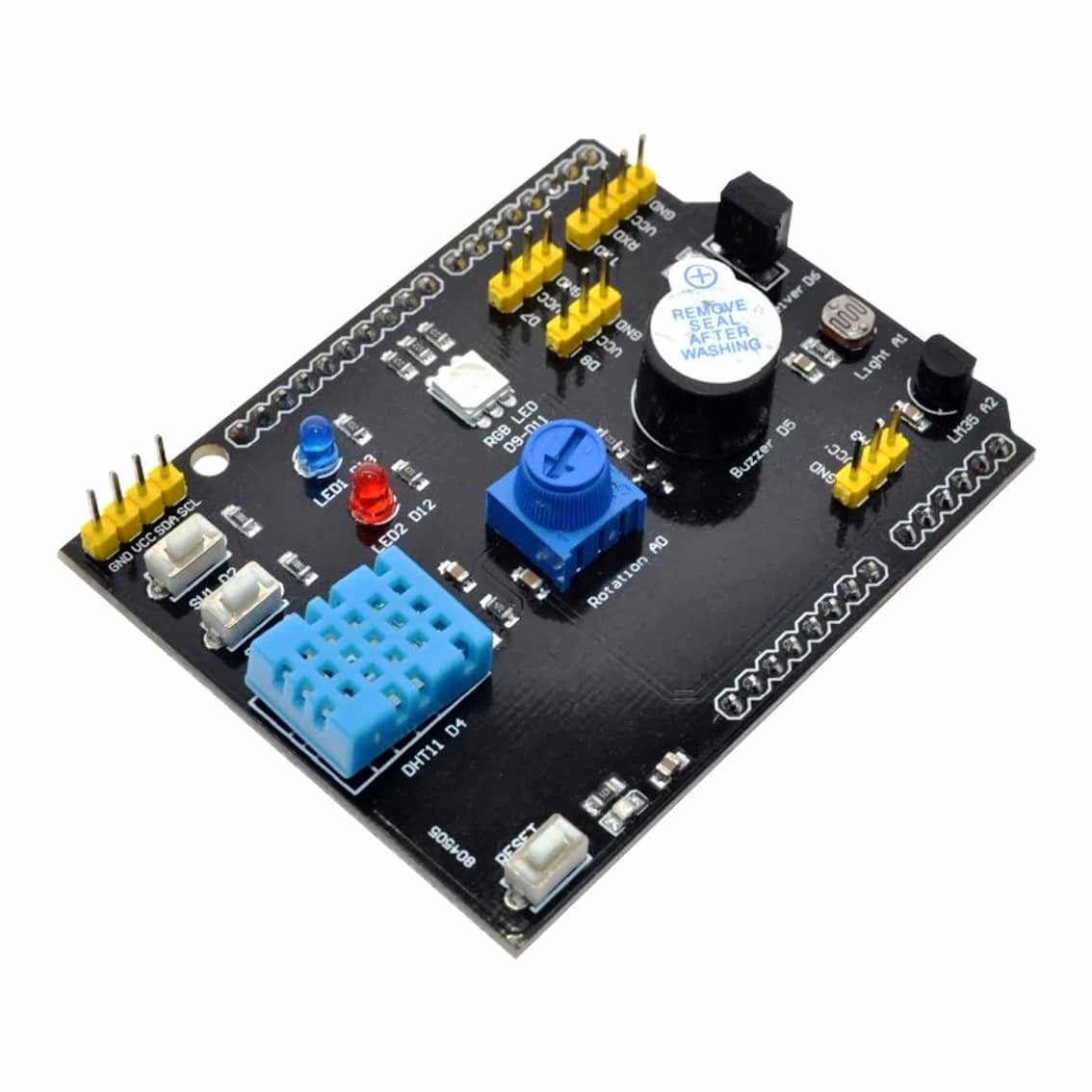
The UNO R3 DHT11 LM35 Temperature Humidity Expansion Shield is an Arduino-compatible sensor shield that combines a DHT11 digital temperature and humidity sensor with an LM35 analogue temperature sensor. It gives UNO R3 projects a convenient way to explore indoor environmental readings, compare two temperature-sensing methods and build simple monitoring experiments without wiring each sensor separately on a breadboard.
The DHT11 reports temperature and relative humidity digitally, while the LM35 provides a temperature-dependent analogue voltage that the Arduino reads through an analogue input. An Arduino UNO R3-compatible controller is required separately unless the package specifically states otherwise.
Key Features
DHT11 Temperature & Humidity
Measures ambient temperature and relative humidity and sends readings to the controller as digital data.
LM35 Analogue Temperature
Provides an analogue voltage proportional to temperature for ADC-based measurement and programming experiments.
Two Temperature Methods
Compare a digital DHT11 reading with an analogue LM35 measurement in the same Arduino project.
UNO R3 Shield Format
Designed to mount on a compatible Arduino UNO R3-style header layout.
Less Breadboard Wiring
Integrates the two named sensors on one expansion board for a neater starter experiment.
Arduino IDE Projects
Use Arduino sketches, analogue input functions and a compatible DHT library to read and process sensor data.
DHT11 Digital Temperature and Humidity Sensor
The onboard DHT11 measures ambient temperature and relative humidity. It uses a digital data interface, so the sensor handles its internal measurement and sends a data packet to the microcontroller rather than providing a simple analogue voltage.
This makes it useful for introductory environmental monitoring, classroom demonstrations, indoor climate experiments and hobby weather-station projects. The DHT11 is an economical general-purpose sensor; it is not intended to replace calibrated precision instruments.
LM35 Analogue Temperature Sensor
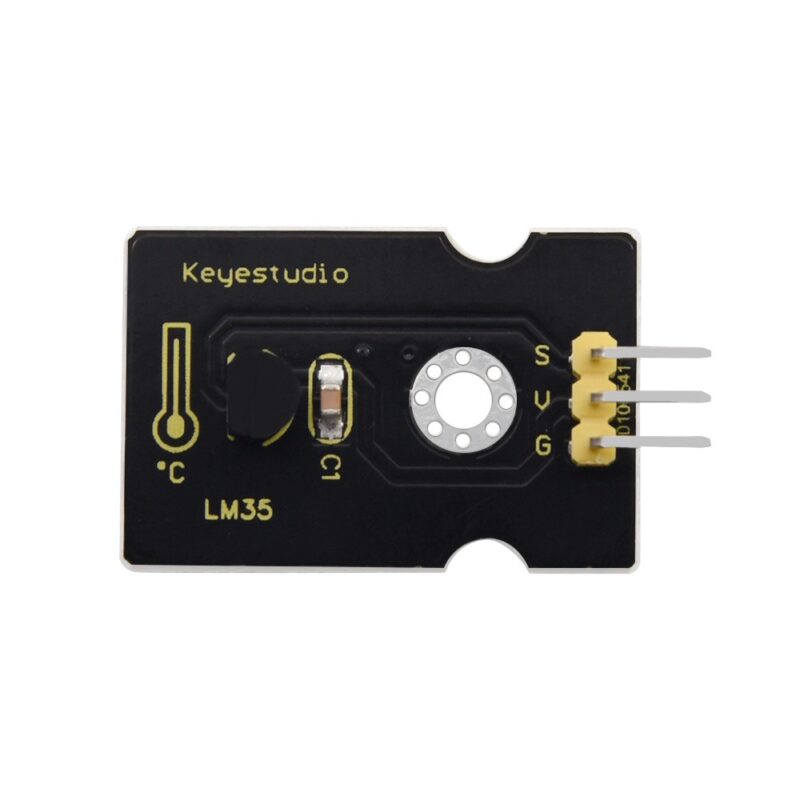
The onboard LM35 measures temperature through an analogue output voltage. The Arduino reads that voltage using its analogue-to-digital converter (ADC), and the sketch converts the result into a temperature estimate.
The commonly used LM35 transfer characteristic is approximately 10 mV per °C. Actual readings depend on the sensor, ADC reference, electrical noise, wiring and the calculation used in the sketch.
Compare Digital and Analogue Temperature Readings
With both sensors on one shield, learners can compare two measurement approaches:
- The DHT11 provides digital temperature and relative humidity data.
- The LM35 provides an analogue voltage that the Arduino converts into a temperature value.
- Measurements can be displayed side by side or sent to a computer over serial.
- Differences between readings can introduce sensor tolerance, resolution, response time and calibration concepts.
Small differences between the two temperature readings are normal. Sensor placement, thermal response and measurement tolerances can affect the results.
Arduino Programming and Projects
Use the Arduino IDE to write and upload sketches to a compatible UNO R3 controller. The LM35 can be read with the standard analogue input functions. The DHT11 is commonly read using a compatible DHT library that handles its digital communication protocol.
Depending on the rest of the circuit and available pins, readings can be sent to the Serial Monitor, displayed on a compatible LCD or OLED, or stored using additional data-logging hardware.
Typical Applications
- Indoor temperature and humidity monitoring
- Arduino environmental sensing experiments
- Educational weather-station prototypes
- Plant-growing and room-condition experiments
- Digital versus analogue sensor demonstrations
- Serial data monitoring and logging projects
- STEM learning and electronics prototyping
- Temperature-threshold automation experiments using suitable driver hardware
Technical Specifications
| Product name |
UNO R3 DHT11 LM35 Temperature Humidity Expansion Shield |
| Product type |
Arduino UNO R3 sensor expansion shield |
| Primary compatibility |
Arduino UNO R3 and compatible UNO shield-layout boards |
| Digital sensor |
DHT11 temperature and humidity sensor |
| DHT11 measurements |
Ambient temperature and relative humidity |
| DHT11 interface |
Digital data |
| Analogue sensor |
LM35 temperature sensor |
| LM35 measurement |
Temperature |
| LM35 interface |
Analogue voltage output |
| LM35 typical transfer characteristic |
Approximately 10 mV per °C |
| Programming environment |
Arduino IDE |
| DHT11 software |
Compatible DHT library commonly used |
| LM35 software |
Arduino analogue input and temperature calculation |
| Controller included |
Arduino UNO R3 not included unless stated in the package |
| Applications |
Environmental monitoring, STEM, sensor learning and prototyping |
Compatibility and Pin Assignment
The shield is designed around the Arduino UNO R3 expansion-header layout. Physical compatibility with another UNO-style board does not automatically guarantee that every sensor signal is routed as expected.
Generic shield versions can use different pin assignments. Check the labels printed on the supplied board or its accompanying documentation/example sketch before selecting the DHT11 data pin or LM35 analogue input in your code. This is especially important when adding other modules that may share the same pins.
Measurement and Usage Notes
- Use the correct DHT11 library and select the data pin specified for your exact shield revision.
- Confirm the LM35 output connection and analogue pin from the board markings before uploading a sketch.
- Allow sensors time to respond to changes in their surroundings; readings may not update instantly.
- Do not treat the DHT11 or LM35 as calibrated laboratory or safety-monitoring instruments.
- For projects that switch fans, motors, heaters or pumps, use a correctly rated relay, MOSFET, transistor or driver circuit. Do not power such loads directly from an Arduino GPIO pin.
- Check the controller and shield supply requirements before powering the assembly.
Frequently Asked Questions
What does the UNO R3 DHT11 LM35 shield measure?
The DHT11 measures temperature and relative humidity. The LM35 provides a separate analogue temperature measurement.
What is the difference between the DHT11 and LM35?
The DHT11 sends digital temperature and humidity data. The LM35 outputs an analogue voltage proportional to temperature, which the Arduino reads through an analogue input.
Does this shield work with Arduino UNO R3?
Yes. It is designed for the Arduino UNO R3 shield layout and compatible UNO-style controllers.
Does the product include an Arduino UNO board?
No. This listing is for the sensor expansion shield. A compatible Arduino UNO R3 controller is needed separately unless the package explicitly states otherwise.
Does the DHT11 require a library?
A compatible DHT library is commonly used to communicate with the DHT11 and read its temperature and humidity values.
Does the LM35 require a special Arduino library?
Not for basic readings. You can use Arduino analogue input functions and convert the measured voltage into a temperature estimate in your sketch.
Can I compare both temperature readings?
Yes. Your sketch can read the DHT11 temperature and calculate the LM35 temperature separately, then display or log both values for comparison.
Can I use it for a weather station?
It can be used for hobby and educational weather-monitoring experiments. The DHT11 is a general-purpose sensor, not a calibrated professional weather instrument.
Why might the two temperature readings differ?
Sensor tolerances, resolution, response time, placement and nearby heat sources can cause small differences. Identical readings should not always be expected.
Which Arduino pins should I use?
Pin assignments can vary between shield revisions. Check the PCB labels or supplied example code to identify the DHT11 data pin and LM35 analogue input for your board.
Can the shield control a fan automatically?
The Arduino can use temperature readings to control a fan through suitable driver hardware. Do not connect a fan directly to an Arduino GPIO pin.
Is it suitable for precision measurement?
It is intended for learning and general-purpose hobby monitoring, not calibrated laboratory, medical or safety-critical measurement.
Why Buy from PcGuy Computers?
| Arduino project range |
Explore compatible development boards, sensor shields and electronics modules. |
| Learning and prototyping |
Find components for STEM activities, sensor experiments and DIY projects. |
| Product information |
Review sensor functions, compatibility notes and practical usage guidance before choosing components. |
The UNO R3 DHT11 LM35 Temperature Humidity Expansion Shield combines digital temperature and humidity sensing with analogue temperature measurement on one Arduino UNO R3-style board. It is a practical platform for environmental monitoring experiments, sensor comparisons and STEM projects.


 Pick up from PcGuy Computers Store


 Pick up from PcGuy Computers Store
 AusPost Standard
 AusPost Express

 Arduino Modules & Sensors
 Battery Compartments
 Component Cases
 Electronics Kits
 Microcontroller Boards
 Project Enclosures
 Shields & Hats
 Tablets
 Laptops
 Laptop Accessories
 CPU (Processor)
 CPU Coolers
 GPU (Graphics)
 HDD/ SSD (Storage)
 MOBO (Motherboard)
 PSU (Power Supply)
 RAM (Memory)
 Keyboard & Mouse Combo
 Keyboards
 Printers
 USB
Reviews
There are no reviews yet.