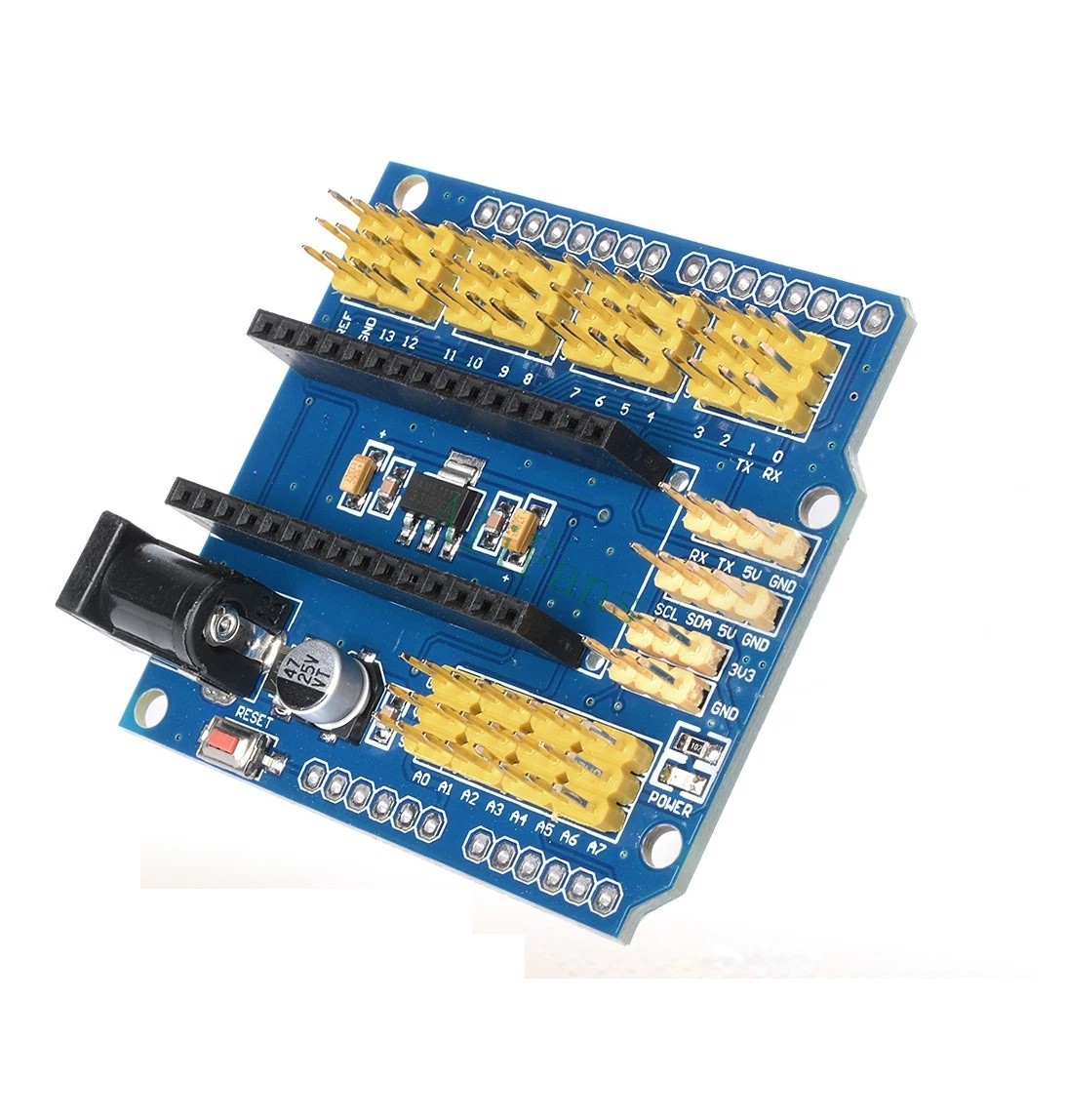
The Nano I/O Expansion Sensor Shield V3.0 makes an Arduino Nano easier to connect to sensors, servos and compatible electronic modules. It breaks out the Nano’s compact pin rows into accessible headers with grouped signal, voltage and ground connections, helping keep prototype wiring organised.
Designed as an interface and breakout board, it uses the Nano’s existing controller and I/O pins; it does not add a separate microcontroller or extra programmable GPIO.
Key Features
Arduino Nano Compatibility
Provides a convenient expansion interface for compatible Arduino Nano-format development boards.
Digital I/O Breakout
Brings the Nano’s digital connections out to accessible headers for switches, LEDs and compatible digital modules.
Analogue Input Access
Provides accessible connections for the Nano’s analogue inputs, useful with potentiometers and analogue sensors.
Grouped G-V-S Headers
Signal, voltage and ground connections are arranged together to simplify wiring for compatible three-wire devices.
Servo-Friendly Connections
Convenient header layout for connecting compatible hobby servos; suitable external power may be needed for servo loads.
Compact Project Expansion
Helps organise sensor and module wiring in robotics, automation, education and electronics prototypes.
How the Nano I/O Expansion Shield Works
Insert a compatible Arduino Nano into the shield’s matching headers. The shield routes the Nano’s existing connections to more accessible breakout points, making it easier to attach external hardware without repeatedly sharing individual power and ground wires on a breadboard.
Your sketches generally continue to use the Nano’s original pin assignments. The shield changes the physical connection layout, not the controller’s programming architecture.
Sensor and Module Connections
Many compatible modules use three connections: Signal for data or control, Voltage for module power, and Ground for the common reference. The grouped headers make these connections easier to organise.
Check each module’s voltage requirement and pin order before connecting it. Similar-looking connectors can use different signal, voltage and ground arrangements.
Servo and External Power Considerations
The header arrangement is convenient for standard three-wire hobby servo connections. The Nano provides the control signal, but servo motors can draw considerably more current than sensors. Do not assume the Nano’s USB connection or onboard regulator can power multiple servos. Use a correctly rated external supply when required and connect grounds appropriately. Check the exact board revision’s power-selection arrangement before applying external power.
Typical Applications
- Arduino Nano sensor experiments
- Robotics and servo-control prototypes
- Digital and analogue sensor projects
- Automation and monitoring systems
- STEM learning and electronics education
- Rapid prototyping and DIY embedded projects
Technical Specifications
| Product |
Nano I/O Expansion Sensor Shield V3.0 |
| Board type |
Arduino Nano I/O and sensor expansion shield |
| Version |
V3.0 |
| Designed for |
Arduino Nano-compatible boards |
| Digital I/O headers |
14 servo-style I/O connections (GND, power and signal) |
| Analogue headers |
8 analogue connections with power and ground |
| PWM connections |
6 PWM pins |
| I2C expansion |
5-pin I2C expansion connection |
| Servo power |
Dedicated servo power input |
| Additional connection |
AREF output |
| Additional voltage output |
3.3V output |
| Main function |
Breakout of existing Nano I/O and power connections |
| Controller included |
No – Nano board is not included |
| Common applications |
Sensors, servos, robotics, automation and prototyping |
Frequently Asked Questions
What is the Nano I/O Expansion Sensor Shield V3.0 used for?
It makes the Arduino Nano’s existing pins easier to access when connecting sensors, servos and compatible electronic modules.
Does this product include an Arduino Nano?
No. This listing is for the expansion shield; the Nano controller is not included.
Which boards are compatible?
It is designed for Arduino Nano-format boards. Confirm that your board uses the matching Nano pin layout before installation.
Does the shield add more programmable pins?
No. It breaks out and reorganises the Nano’s existing I/O connections; it does not add a second controller or extra GPIO.
Can I connect analogue sensors?
Yes. The Nano’s analogue input connections are accessible through the shield for compatible analogue sensors and modules.
Can I use the shield with digital sensors?
Yes. Its digital I/O breakout connections can be used with compatible digital sensors, switches and modules.
Can I connect hobby servos?
The grouped signal, voltage and ground headers are convenient for compatible three-wire servos. Make sure the power source can supply the required current.
Can the Nano power several servos?
Not necessarily. Multiple servos can exceed the current available from USB or the Nano regulator. Use a suitably rated external supply when needed and follow the board’s power instructions.
Will my Arduino code need to change?
Usually not. The shield exposes the Nano’s existing pins, so sketches normally retain the same pin numbers and libraries.
Are all three-pin sensor connectors wired the same way?
No. Check the individual module’s signal, voltage and ground pin order and operating voltage before connecting it.
Does the shield replace a breadboard?
It can reduce breadboard wiring for compatible connections, but a breadboard may still be useful for circuits that need custom connections or components.
What projects can use this expansion shield?
It is useful for Nano-based robotics, sensor monitoring, automation, educational experiments and general electronics prototyping.
Why Buy from PcGuy Computers?
| Arduino project range |
Browse related Nano boards, sensors, modules and expansion accessories. |
| Project selection |
Find components for robotics, automation, STEM learning and prototyping in one electronics catalogue. |
| Practical product details |
Review compatibility notes and connection guidance before choosing components. |
The Nano I/O Expansion Sensor Shield V3.0 is a practical breakout accessory for organising Arduino Nano sensor, servo and module connections. It provides easier access to existing I/O pins for compact electronics projects.


 Pick up from PcGuy Computers Store


 Arduino Modules & Sensors
 Battery Compartments
 Component Cases
 Electronics Kits
 Microcontroller Boards
 Project Enclosures
 Shields & Hats
 Tablets
 Laptops
 Laptop Accessories
 CPU (Processor)
 CPU Coolers
 GPU (Graphics)
 HDD/ SSD (Storage)
 MOBO (Motherboard)
 PSU (Power Supply)
 RAM (Memory)
 Keyboard & Mouse Combo
 Keyboards
 Printers
 USB

Reviews
There are no reviews yet.