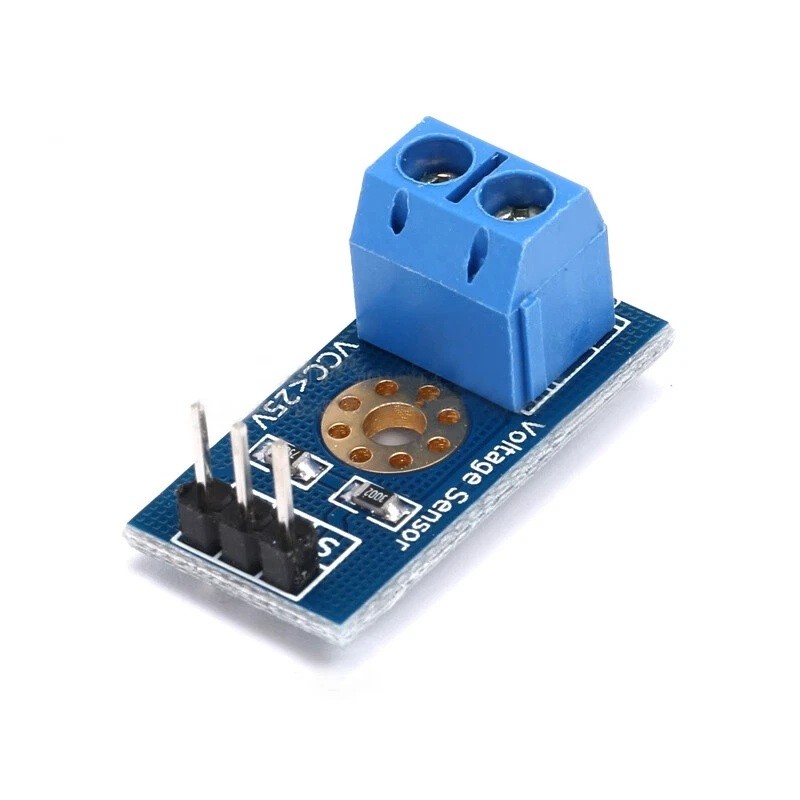
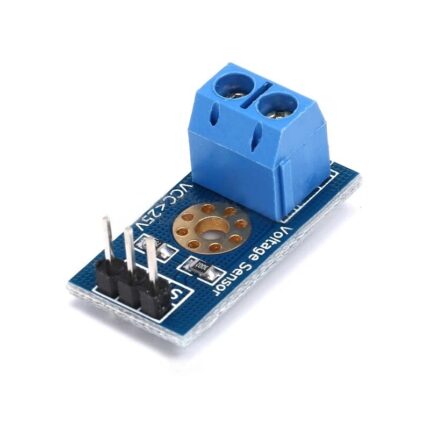
The DC 0–25V Terminal Voltage Sensor Module is an analogue DC voltage measurement board that uses a resistive voltage divider to scale an input voltage down to approximately one-fifth of its original value. It lets an Arduino or another compatible controller monitor DC sources such as batteries and regulated power supplies through an analogue input, provided the controller’s ADC voltage limit is respected.
Key Features
0–25V DC Input Range
Designed to monitor positive DC input voltages up to 25V at the screw terminal.
5:1 Voltage Divider
Reduces the terminal input voltage to approximately one-fifth at the analogue signal output.
Analogue Signal Output
Provides a scaled voltage signal that a compatible microcontroller ADC can read.
Screw Terminal Input
Terminal block makes it convenient to connect the positive and negative wires of a DC source.
Simple Controller Interface
Connect the signal and ground to a suitable analogue input and common ground on your controller.
Battery and Power Monitoring
Useful for battery-level experiments, DC supply monitoring and electronics learning projects.
Technical Specifications
| Product Type |
DC terminal voltage sensor module |
| Measurement Type |
Positive DC voltage |
| Input Voltage Range |
0–25V DC maximum |
| Measurement Principle |
Resistive voltage divider |
| Divider Ratio |
Approximately 5:1 |
| Output Type |
Analogue voltage signal |
| Input Connection |
2-pin screw terminal |
| Controller Connection |
3-pin interface; signal and ground, with third pin depending on board layout |
| Maximum Signal at 25V Input |
Approximately 5V |
| 3.3V ADC Input Limit |
Keep measured input at or below approximately 16.5V |
| Applications |
Battery, DC supply and voltage monitoring projects |
Compatible Controllers
This module can be used with controllers that have an analogue input and suitable voltage limits:
- Arduino Uno and other 5V analogue-input boards
- ESP32 boards, within the selected ADC pin’s voltage limit
- ESP8266 boards, within the ADC input limit of the exact board
- Other microcontrollers with compatible analogue inputs
Important: Raspberry Pi boards do not have a built-in analogue input. Use a suitable external ADC and ensure its input voltage is not exceeded.
Applications
- Monitoring 12V batteries and DC power supplies
- Arduino battery voltage display projects
- Solar and low-voltage DC experiments
- Power supply monitoring and DIY meters
- Robotics and embedded electronics projects
- STEM and microcontroller learning activities
Connection and Setup Guide
- Check the module’s printed labels before wiring. Connect the positive DC source to the terminal marked VCC or positive, and its negative to GND or negative.
- Connect the module’s analogue signal pin (often marked S) to a suitable analogue input on your controller.
- Connect module ground to the controller ground to establish a common reference.
- Check the board’s 3-pin header labels. Do not assume the third pin is a power input; some versions mark it NC or use a different layout.
- Read the analogue value in your code and multiply the measured signal voltage by approximately five to estimate the terminal input voltage.
- Compare the reading with a multimeter and calibrate in software for resistor tolerance and ADC reference variation.
Important Before Buying
- DC only: This module is intended for positive DC voltage measurement, not AC mains measurement.
- Do not exceed 25V: Applying more than the rated input can overdrive the divider and damage the module or connected controller.
- 3.3V controller limit: With a 3.3V ADC, keep the measured input at or below approximately 16.5V so the divided signal stays within 3.3V. Check the exact ADC pin rating.
- Common ground: The module and controller need a shared ground for a meaningful analogue reading.
- Not galvanically isolated: The resistor divider does not provide electrical isolation from the measured circuit.
- Resolution depends on your ADC: Actual measurement resolution and accuracy depend on the controller’s ADC, reference voltage, resistor tolerances and calibration.
Frequently Asked Questions
What is the DC 0–25V voltage sensor module used for?
It scales a positive DC voltage through a resistor divider so a compatible microcontroller analogue input can monitor batteries, power supplies and other DC sources.
What is the maximum input voltage?
The module is designed for a maximum input of 25V DC. Do not exceed this rating.
How does the voltage divider work?
It reduces the input voltage to approximately one-fifth. For example, a 12V input produces about 2.4V at the signal output.
Can I use it with Arduino Uno?
Yes. Its scaled analogue output can be read by an Arduino Uno analogue pin. Connect the grounds together and use the divider ratio in your voltage calculation.
Can I use it with ESP32 or ESP8266?
Yes, provided the divided signal never exceeds the analogue input limit of the exact board and ADC pin. For a 3.3V ADC, keep the module input at or below approximately 16.5V.
Can it measure a 12V battery?
Yes. A 12V DC battery is within the module’s stated input range. The signal output is approximately 2.4V, before component tolerances and measurement variation.
Can I connect it directly to a Raspberry Pi?
No. Raspberry Pi boards generally do not include a built-in analogue input. Use a compatible external ADC and keep its input within the ADC’s rated voltage.
Does this module measure AC voltage?
No. It is intended for DC voltage measurement. Do not connect AC mains or use it as an isolated AC measurement device.
Why Buy from PcGuy Computers?
- Electronics and development modules for makers, students and engineers in Pakistan
- Product details to help you choose compatible components
- Convenient online ordering from PcGuy Computers
- Support for product-related queries
Buy DC 0–25V Terminal Voltage Sensor Module in Pakistan
Monitor batteries and DC power sources in your Arduino and electronics projects with this DC 0–25V Terminal Voltage Sensor Module. Order online from PcGuy Computers for your voltage monitoring and STEM applications.
 Pick up from PcGuy Computers Store
 AusPost Standard
 AusPost Express



 Arduino Modules & Sensors
 Battery Compartments
 Component Cases
 Electronics Kits
 Microcontroller Boards
 Project Enclosures
 Shields & Hats
 Tablets
 Laptops
 Laptop Accessories
 CPU (Processor)
 CPU Coolers
 GPU (Graphics)
 HDD/ SSD (Storage)
 MOBO (Motherboard)
 PSU (Power Supply)
 RAM (Memory)
 Keyboard & Mouse Combo
 Keyboards
 Printers
 USB
Reviews
There are no reviews yet.