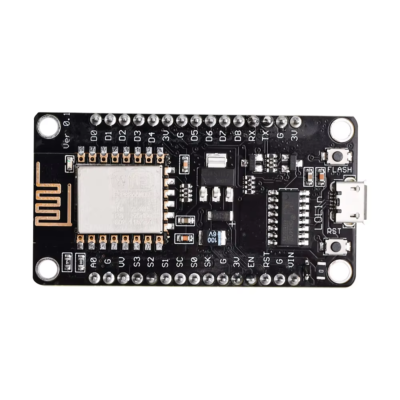
The NodeMCU CH340G WiFi ESP8266 ESP-12E USB Micro Development Board is a compact microcontroller platform for wireless IoT, automation and DIY electronics. It combines an ESP8266 ESP-12E Wi-Fi module with a CH340G USB-to-serial interface, allowing you to program the board through Micro USB using the ESP8266 Arduino Core or compatible NodeMCU Lua firmware.
Key Features
ESP8266 ESP-12E Wi-Fi
Integrated 2.4GHz 802.11 b/g/n wireless connectivity for connected devices and IoT prototypes.
CH340G USB-to-Serial
Onboard CH340G bridge allows firmware uploads and serial monitoring through the Micro USB port.
Arduino IDE and Lua
Develop using the ESP8266 Arduino Core or compatible NodeMCU Lua firmware.
GPIO for Project I/O
Connect compatible digital sensors, LEDs, relays and displays using the board’s exposed GPIO pins.
Compact USB-Powered Board
Micro USB provides a convenient 5V input to the onboard regulator for prototyping.
Built for IoT Experiments
Create Wi-Fi sensors, simple web servers, remote monitoring and smart-home prototypes.
Technical Specifications
| Board / module |
NodeMCU ESP-12E development board |
| Main controller |
ESP8266EX (Tensilica L106 32-bit) |
| Wi-Fi |
2.4GHz IEEE 802.11 b/g/n |
| USB-to-serial |
CH340G |
| USB connector |
Micro USB |
| Logic / GPIO voltage |
3.3V (GPIO is not 5V tolerant) |
| Power input |
5V via Micro USB; board regulator supplies 3.3V |
| CPU clock |
80MHz default; up to 160MHz supported |
| Flash memory |
Typically 4MB on NodeMCU ESP-12E boards; verify exact board revision |
| Analogue input |
1 ADC channel (A0); input range depends on board divider |
| Programming |
ESP8266 Arduino Core / NodeMCU Lua |
| Wireless modes |
Station, SoftAP and combined Station + SoftAP |
Compatible Devices and Development Tools
- Windows, macOS and Linux computers with a suitable USB serial driver and development environment
- Arduino IDE with the ESP8266 Arduino Core
- NodeMCU Lua firmware and compatible flashing tools
- 3.3V logic-compatible digital sensors, displays and control modules
- Wi-Fi routers and access points using supported 2.4GHz wireless settings
Applications
- Wi-Fi-enabled sensor nodes and remote monitoring
- Smart home prototypes and connected switches
- Small web servers and network dashboards
- Wireless data logging and environmental monitoring
- IoT learning, automation experiments and STEM projects
Connection and Setup Guide
- Install the Arduino IDE and add the ESP8266 community board package through Boards Manager.
- Connect the board to your computer using a Micro USB data cable.
- If no serial port appears, install the appropriate CH340G USB-to-serial driver and reconnect the board.
- Select NodeMCU 1.0 (ESP-12E Module) in the board menu and choose the detected COM/serial port.
- Upload a simple Blink or Wi-Fi scan example to check programming and connectivity.
- Connect external sensors only after checking the board pin labels, GPIO mapping, voltage levels and current requirements.
Important Before Buying
- 3.3V logic only: ESP8266 GPIO pins are not 5V tolerant. Use a suitable level shifter or divider for 5V signals.
- Power stability: Wi-Fi transmission causes current peaks. Use a stable USB supply and cable; avoid powering high-current peripherals from the board’s regulator.
- A0 input: The allowable ADC voltage depends on the onboard divider and board revision. Verify before connecting an analogue sensor.
- Boot pins: External circuits connected to GPIO0, GPIO2 and GPIO15 (often labelled D3, D4 and D8) can prevent normal startup if they force the wrong boot level.
- Flash size: 4MB is common on ESP-12E NodeMCU boards, but confirm the actual board revision and detected flash capacity.
- USB cable and headers: A data-capable Micro USB cable is required for programming. Included cable and pre-soldered headers are not confirmed for this listing.
- Wireless band: ESP8266 Wi-Fi is 2.4GHz; it does not connect to 5GHz-only Wi-Fi networks.
Frequently Asked Questions
Does this board have built-in Wi-Fi?
Yes. The ESP8266 ESP-12E module supports 2.4GHz 802.11 b/g/n Wi-Fi.
Can I program it with Arduino IDE?
Yes. Install the ESP8266 board package, select NodeMCU 1.0 (ESP-12E Module), choose the correct serial port and upload a sketch.
What is the CH340G used for?
It converts USB data to serial UART communication so the computer can upload firmware and communicate with the ESP8266.
Does it use 5V GPIO?
No. ESP8266 GPIO operates at 3.3V and is not 5V tolerant. Use suitable level shifting for 5V signals.
How much flash memory does it have?
Many NodeMCU ESP-12E boards use 4MB flash, but clone board revisions can vary. Check the detected flash size or board documentation.
How many analogue inputs are available?
The board exposes one ADC input, A0. Its allowable voltage range depends on the onboard divider; check the exact board schematic before applying an analogue voltage.
Does it need a special USB driver?
Some computers need a CH340 driver before the board appears as a serial/COM port. Use a USB data cable, not a charge-only cable.
Can I power motors or relays directly from its GPIO?
No. GPIO pins are for logic signals and have limited current capability. Use a suitable transistor, MOSFET or driver module and a separate supply for loads.
Why Buy from PcGuy Computers?
PcGuy Computers offers development boards and electronics accessories for students, makers and IoT projects in Pakistan. Contact the store if you need confirmation of the exact board revision, flash size or included headers before ordering.
Buy NodeMCU CH340G ESP8266 ESP-12E Board in Pakistan
Order the NodeMCU CH340G ESP8266 ESP-12E development board from PcGuy Computers for 2.4GHz Wi-Fi projects, wireless sensors and Arduino-compatible IoT prototyping. Check GPIO voltage and board pinout before connecting external hardware.
 Pick up from PcGuy Computers Store


 Pick up from PcGuy Computers Store
 AusPost Standard
 AusPost Express
 Arduino Modules & Sensors
 Battery Compartments
 Component Cases
 Electronics Kits
 Microcontroller Boards
 Project Enclosures
 Shields & Hats
 Tablets
 Laptops
 Laptop Accessories
 CPU (Processor)
 CPU Coolers
 GPU (Graphics)
 HDD/ SSD (Storage)
 MOBO (Motherboard)
 PSU (Power Supply)
 RAM (Memory)
 Keyboard & Mouse Combo
 Keyboards
 Printers
 USB
Reviews
There are no reviews yet.