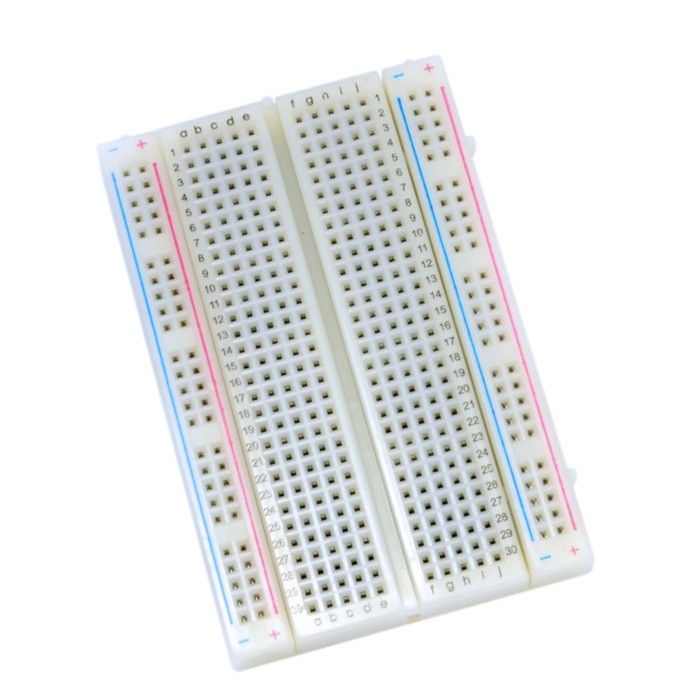
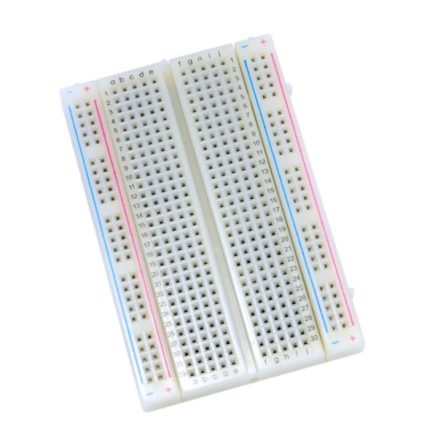
The 400 Tie Points Breadboard is a compact solderless prototyping board for assembling, testing and modifying low-voltage electronic circuits without soldering. It provides 400 connection points with standard 2.54mm (0.1-inch) spacing, a centre channel for compatible DIP integrated circuits and reusable spring contacts. Use it for Arduino, ESP32, sensor, LED, logic IC and STEM education projects.
Key Features
400 Tie Points
Provides connection space for compact circuits, component experiments and small prototypes.
Solderless Spring Contacts
Insert compatible component leads and jumper wires to create temporary electrical connections without soldering.
Standard 2.54mm Pitch
Works with many common through-hole components, pin headers and breadboard-compatible jumper wires.
Centre DIP Channel
Position compatible dual in-line package ICs across the centre gap to keep opposite pin rows separated.
Compact Half-Size Format
A practical choice for smaller projects where a full-size 830-point board may take up unnecessary space.
Reusable Prototyping
Change component placement, test circuit layouts and reuse the board for subsequent experiments.
400 Tie Points for Solderless Circuit Building
The board uses internal conductive spring contacts to connect groups of holes. Component leads and compatible jumper wires can be inserted into these contacts to form temporary circuit nodes. This makes it easier to experiment with wiring, replace components and troubleshoot a design before building a permanent circuit.
2.54mm Component Spacing and Centre Channel
The standard 2.54mm (0.1-inch) pitch suits many common through-hole components, including resistors, LEDs, capacitors, diodes, transistors, push buttons, pin headers and compatible DIP ICs. The centre channel separates the two main terminal areas so a compatible DIP package can straddle the gap with its two pin rows on separate sides.
For Arduino, ESP32 and Sensor Projects
Connect a compatible development board to the breadboard using suitable male-ended Dupont jumper wires. It can provide a convenient workspace for LED circuits, buttons, potentiometers, sensor interfaces, transistor experiments, logic ICs and microcontroller GPIO projects.
- Arduino UNO and Mega circuit experiments
- Compatible ESP32 and ESP8266 development boards
- Raspberry Pi GPIO learning circuits
- LEDs, buttons, resistors and potentiometers
- Temperature, light and other sensor interfaces
- 555 timer, logic IC and transistor experiments
Check the physical dimensions and header layout of your development board before mounting or wiring it. ESP32, ESP8266 and Raspberry Pi GPIO generally use 3.3V logic; the breadboard does not convert voltage levels.
Understand the Breadboard Connection Layout
Holes in the main terminal area are joined in groups by conductive metal clips underneath the board. Holes in the same connected group share an electrical node. The centre channel separates the two terminal sections for compatible DIP IC placement.
Some breadboards have side power rails, and their continuity can vary by model or revision. Do not assume a rail is connected along its full length. If uninterrupted continuity matters, verify it with a multimeter before wiring the circuit.
Designed for Low-Voltage Prototyping
A solderless breadboard is a passive connection platform. It does not provide voltage regulation, current limiting, logic-level conversion, reverse-polarity protection, short-circuit protection or over-current protection. These functions must be provided by the circuit and its power system where required.
Use the board for low-voltage, relatively low-current experiments. Do not use it for exposed mains-voltage circuits or as a high-current power distribution board. Motors, pumps, solenoids, heaters and other substantial loads need suitable external drivers, power supplies and correctly rated wiring.
400 Tie Points vs 830 Tie Points
A 400-point breadboard is a compact option for smaller circuits, basic Arduino experiments and portable prototypes. A common 830-point format, such as the MB-102 style, provides more working area for larger circuits with multiple ICs or several circuit sections. Choose according to the number of components and the space your project needs.
Product Specifications
| Product Type |
Solderless breadboard |
| Total Tie Points |
400 |
| Pitch |
2.54mm / 0.1 inch |
| Format |
Compact / half-size breadboard |
| Connection Type |
Internal spring contacts |
| Centre Channel |
Yes, for compatible DIP ICs |
| Soldering Required |
No |
| Reusable |
Yes |
| Typical Components |
Jumper wires, DIP ICs and through-hole components |
| Applications |
Arduino, microcontrollers, circuit testing, STEM and electronics prototyping |
What’s Included?
- 1 x 400 Tie Points Breadboard
Development boards, jumper wires, power supplies and electronic components are not included unless a specific bundle listing states otherwise.
Frequently Asked Questions
How many connection points does this breadboard have?
It provides 400 tie points for compatible jumper wires and electronic component leads.
Does it require soldering?
No. Internal spring contacts hold compatible component leads and jumper wires to create temporary connections.
Can I reuse the breadboard?
Yes. Remove the components and jumper wires after an experiment and reuse the board for another prototype.
Can I use it with Arduino UNO or Mega?
Yes. Suitable male-to-male Dupont jumper wires can connect Arduino UNO or Mega pins to components on the breadboard.
Can I use Dupont jumper wires?
Yes. Male-ended Dupont jumper wires are commonly used to connect development boards, modules and components to a solderless breadboard.
Can I install DIP integrated circuits?
Compatible DIP ICs can be placed across the centre channel so the pins on each side connect to separate terminal groups. Check package width and pin spacing for fit.
Is this a full-size breadboard?
No. It is a compact 400 tie point format, commonly described as half-size, compared with a typical 830 tie point breadboard.
Are the side power rails connected all the way through?
Power-rail layouts vary between manufacturers and revisions. Check continuity with a multimeter if you need to confirm whether a rail is split.
Can I use it with ESP32 or ESP8266?
Yes, if the particular development board fits the breadboard layout and has compatible headers. These controllers generally use 3.3V GPIO logic; the breadboard does not provide level shifting.
Can I connect Raspberry Pi GPIO to it?
Yes, using suitable jumper wires. Raspberry Pi GPIO uses 3.3V logic, so avoid applying incompatible higher-voltage signals.
Can I use it to power motors or pumps?
Do not route substantial motor or pump current through a small solderless breadboard. Use an appropriately rated driver, external power supply and suitable wiring.
Can I use this breadboard for 240V mains circuits?
No. Hobby solderless breadboards are intended for low-voltage prototyping and do not provide the insulation, enclosure or safety clearances required for mains electrical work.
Are jumper wires and components included?
The listed package includes one 400 tie points breadboard. Development boards, jumper wires, power supplies and other components are separate unless a bundle listing says otherwise.
Why Buy from PcGuy Computers?
| Pakistan-Focused Support |
Product information and practical guidance for customers in Pakistan. |
| Pakistan-Wide Shipping Options |
Shipping options can be selected according to destination and service availability. |
| Related Project Components |
Explore Arduino boards, jumper wires, sensors, modules and prototyping accessories for related builds. |
| Practical Product Guidance |
Clear specifications and compatibility notes help you plan your electronics project. |
Buy the 400 Tie Points Breadboard in Pakistan for compact solderless circuit building, Arduino experiments, electronics education, component testing and rapid prototyping.
 Pick up from PcGuy Computers Store
 AusPost Standard
 AusPost Express


 Arduino Modules & Sensors
 Battery Compartments
 Component Cases
 Electronics Kits
 Microcontroller Boards
 Project Enclosures
 Shields & Hats
 Tablets
 Laptops
 Laptop Accessories
 CPU (Processor)
 CPU Coolers
 GPU (Graphics)
 HDD/ SSD (Storage)
 MOBO (Motherboard)
 PSU (Power Supply)
 RAM (Memory)
 Keyboard & Mouse Combo
 Keyboards
 Printers
 USB
Reviews
There are no reviews yet.