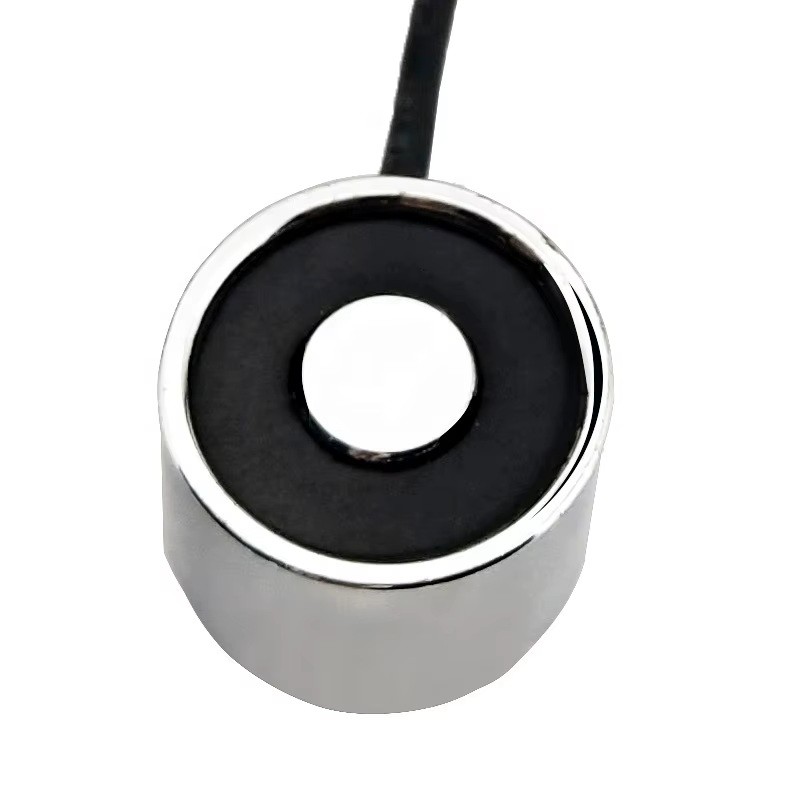
P25/20 5kg 12V Lifting Magnet Electromagnetic Solenoid is a compact DC holding electromagnet designed to attract and hold compatible iron and steel objects while its coil is energised. With an approximately 25mm diameter and 20mm body height, it is suitable for small robotics mechanisms, magnetic latches, sorting prototypes and DIY automation projects. Its 5kg figure is a nominal holding-force rating under ideal contact conditions—not a guaranteed safe lifting load.
Key Features
12V DC Electromagnetic Operation
Connect to a suitable 12V DC source to energise the internal coil and create magnetic attraction. The main holding force is available while power is applied.
Up to 5kg Nominal Holding Force
Designed for strong contact holding against suitable ferromagnetic steel. Actual performance depends on the workpiece, contact surface, air gap and load direction.
Compact 25mm Diameter Body
The small cylindrical format helps integrate the magnet into compact robotic assemblies, fixtures and custom mechanisms.
Low-Profile 20mm Height
The approximately 20mm body height supports space-conscious installations where a larger electromagnet may not fit.
Switchable Magnetic Holding
Use a suitable relay, MOSFET or transistor driver to control when the magnet is energised and when the workpiece is released.
Useful for Small Automation Builds
Suitable for prototype material handling, magnetic latches, small pick-and-place experiments and robotics projects involving compatible metal objects.
How the P25/20 Electromagnet Works
When 12V DC is applied, current flows through the internal coil and creates a magnetic field. The magnet attracts ferromagnetic materials—particularly iron and many types of steel—when the workpiece makes suitable contact with its magnetic face.
When power is removed, most of the magnetic holding force disappears and the object can be released. A small amount of residual magnetism may remain depending on the workpiece and operating conditions.
Understanding the 5kg Holding Rating
The stated 5kg rating is a nominal maximum holding-force figure under favourable test conditions. It should not be interpreted as a guaranteed practical lifting capacity. Some supplier guidance for this style of magnet recommends allowing a substantial safety margin because real pickup performance can be much lower than the static holding rating.
- Use a clean, flat ferromagnetic contact surface.
- Ensure the steel workpiece has adequate thickness and magnetic properties.
- Minimise air gaps caused by paint, rust, dirt, coatings or uneven surfaces.
- Keep the load aligned with the magnetic face and avoid relying on sideways or sliding force.
- Test the complete assembly and establish a conservative working load.
A nominal holding-force rating is not a certified safe working load. Do not suspend loads above people or rely on this component as the sole support in a safety-critical lifting application. Use suitable mechanical retention and guarding.
Compact P25/20 Design
The P25/20 format is approximately 25mm in diameter and 20mm high. This compact footprint is useful for small fixtures, robotics projects, experimental machines and installations where mounting space is limited.
Suitable Applications
- Small robotic arms and magnetic gripper prototypes
- Pick-and-place experiments involving steel parts
- Magnetic latches and electrically controlled holding
- Small parts sorting and material handling
- Positioning fixtures and prototype mechanisms
- DIY machinery, electronics and STEM projects
Control with Arduino, ESP32 & Other Controllers
This electromagnet must not be powered directly from an Arduino, ESP32, Raspberry Pi or other microcontroller GPIO pin. Use a separate, suitably rated 12V DC supply and an external switching stage such as a correctly rated MOSFET, transistor driver or relay module.
The coil is an inductive load and can generate a voltage spike when switched off. Use a suitable flyback diode or equivalent suppression circuit selected for the driver and required release response. Follow the switching component’s wiring and rating requirements.
Power Supply & Operating Considerations
Use a stable 12V DC supply and confirm the current requirement of the exact supplied version before selecting the power adapter or driver. Electromagnetic coils generate heat while energised, so do not assume continuous-duty operation unless it is confirmed for the supplied unit. Monitor temperature during testing and allow suitable cooling.
Product Specifications
| Model |
P25/20 |
| Product Type |
DC Holding / Lifting Electromagnet |
| Operating Voltage |
12V DC |
| Nominal Holding Force |
Up to 5kg under ideal conditions |
| Body Diameter |
Approx. 25mm |
| Body Height |
Approx. 20mm |
| Operation |
Energised to produce magnetic holding force |
| Target Material |
Ferromagnetic iron and suitable steel |
| Control |
External relay, MOSFET or suitable driver circuit |
| Typical Uses |
Robotics, magnetic holding, sorting and automation prototypes |
Exact current draw, power consumption, mounting thread, cable length and duty cycle can vary between supplier versions. Confirm the label or supplied specification before finalising the power supply and mechanical installation.
Material Compatibility
The electromagnet is intended for ferromagnetic materials such as iron and many types of steel. It will not provide useful holding force on aluminium, copper, brass, plastic, timber or glass. Some stainless-steel grades are magnetic while others are not, so test the actual workpiece if compatibility is uncertain.
Installation & Safety Notes
- Use the specified 12V DC supply; do not over-voltage the coil.
- Choose a supply and switching device suitable for the exact unit’s current draw.
- Keep the magnetic contact face clean and flat.
- Minimise gaps between the magnet and workpiece.
- Use flyback or equivalent suppression when switching electronically.
- Secure wiring against movement and mechanical strain.
- Monitor coil temperature during operation.
- Test actual holding force in the completed project.
- Add mechanical retention wherever accidental release could cause injury or damage.
Why Buy from PcGuy Computers?
✓ Pakistan-Wide Order Support
✓ Help with Product Selection
✓ Clear Product Information
✓ Electronics & Robotics Components
✓ After-Sales Order Assistance
PcGuy Computers offers electronics, modules and robotics components for makers, students, technicians and engineering projects across Pakistan.
Frequently Asked Questions
What voltage does the P25/20 electromagnet use?
This model is listed for a 12V DC supply. Confirm the rating on the supplied unit before connecting it.
Does it really lift 5kg?
5kg is a nominal maximum holding-force rating under ideal contact conditions, not a guaranteed practical lifting capacity or certified safe working load. Real-world pickup capacity can be substantially lower.
What are the dimensions?
The P25/20 body is approximately 25mm in diameter and 20mm high.
Does it remain magnetic when power is off?
No. Most of its magnetic holding force is lost when the coil is de-energised, although a small amount of residual magnetism may remain.
Can I connect it directly to an Arduino or ESP32?
No. Do not power the coil from a GPIO pin. Use a separate 12V supply and a suitably rated relay, MOSFET or transistor driver.
Do I need flyback protection?
Flyback or equivalent inductive-load suppression is strongly recommended when switching the coil electronically because it can generate a voltage spike when switched off.
Will it attract aluminium or copper?
No. Aluminium and copper are non-ferromagnetic and will not provide the expected holding force. Use suitable iron or steel workpieces.
Can paint or rust reduce holding force?
Yes. Paint, rust, dirt and surface gaps reduce effective contact and can significantly lower magnetic holding force.
Can it be used as a small robot gripper?
It can be used as a magnetic gripper for compatible ferromagnetic objects when the driver, power supply and mechanical design are suitable.
Is it suitable for continuous operation?
Do not assume continuous-duty operation unless the exact supplied version is rated for it. The coil can heat while energised; confirm duty-cycle details and monitor temperature.


 Pick up from PcGuy Computers Store


 Pick up from PcGuy Computers Store
 AusPost Standard
 AusPost Express

 Arduino Modules & Sensors
 Battery Compartments
 Component Cases
 Electronics Kits
 Microcontroller Boards
 Project Enclosures
 Shields & Hats
 Tablets
 Laptops
 Laptop Accessories
 CPU (Processor)
 CPU Coolers
 GPU (Graphics)
 HDD/ SSD (Storage)
 MOBO (Motherboard)
 PSU (Power Supply)
 RAM (Memory)
 Keyboard & Mouse Combo
 Keyboards
 Printers
 USB
Reviews
There are no reviews yet.